
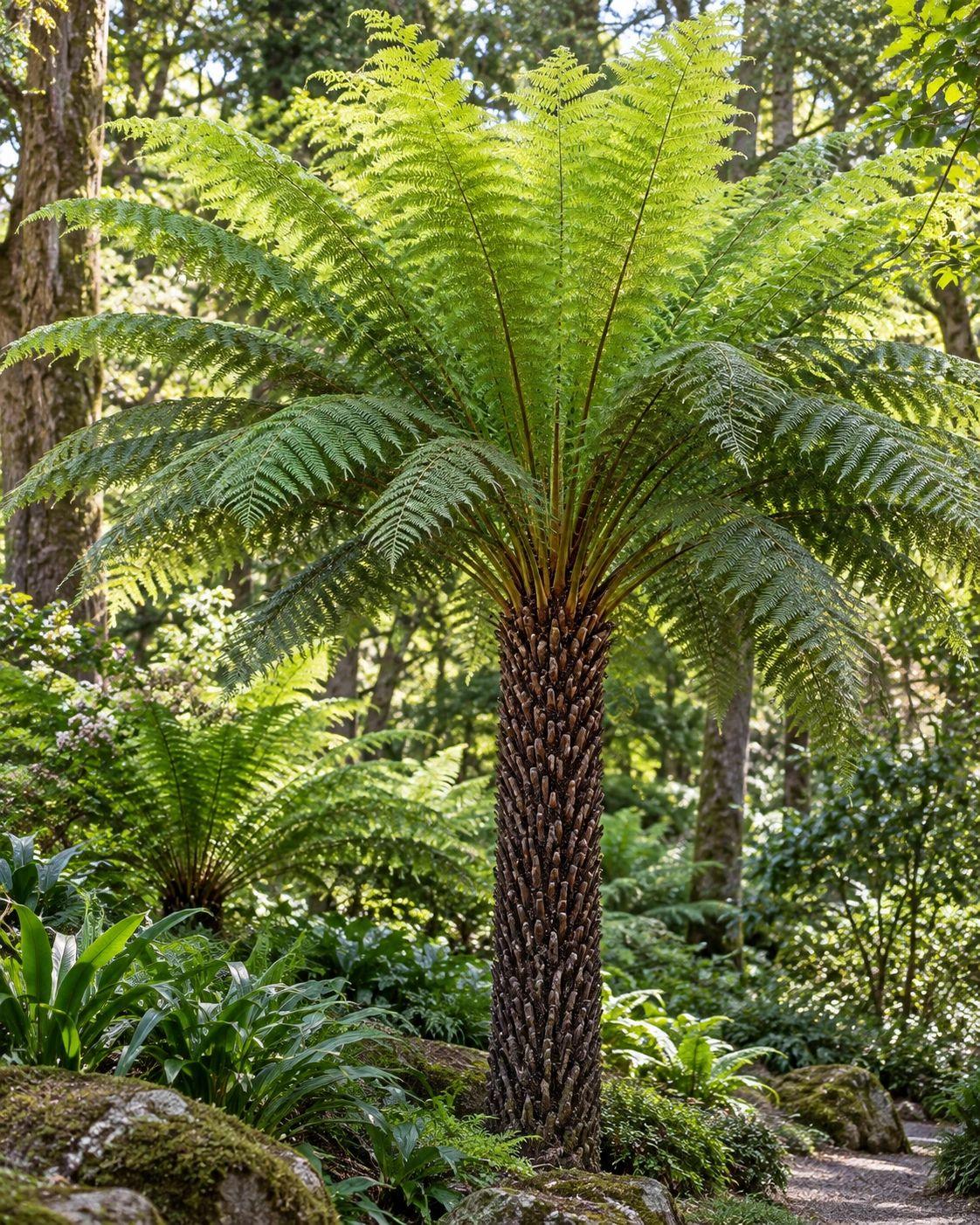
A tree fern has no business in a Wisconsin yard. I keep thinking about one anyway.
The plant is Dicksonia antarctica, the soft tree fern from Tasmania and the cool, wet forests of southeastern Australia. Picture a shaggy brown trunk, a crown of lacy fronds that can stretch nine or ten feet, and a look that belongs in Jurassic Park more than Ozaukee County.
The numbers are not encouraging. The Royal Horticultural Society rates it H3, hardy only in the mild coastal parts of the UK, roughly 23 to 34°F. Sunset's Western Garden Book puts established plants at about 20°F. My corner of southeastern Wisconsin sees below zero most winters. That's not a gap. That's a canyon.
Here's what makes me curious. The trunk isn't wood. It's a column of matted fibrous roots wrapped around a soft core, which is why UK growers water the trunk itself all summer. And everything that matters lives in one place, the crown at the very top. Sound familiar? That's how a palm works. One growing point. Protect it and you protect the plant. Lose it and nothing comes back.
Growers in Vancouver have been doing a version of this for years. At VanDusen Botanical Garden the fronds come off in late November, the trunk gets wrapped, and the fern sits inside a chicken wire cage stuffed with dry oak leaves with plastic over the top. The cover comes off in mid March and a new crown follows. One grower on that same forum lost a fern with three feet of trunk at about 16°F, and the cold wasn't really the cause. The cover leaked, and water froze in the crown.
That's the line that got my attention. Moisture in the crown is the killer, and it's exactly why I stand by the box instead of the tight wrap for my palms. The air gap is about keeping the plant dry as much as keeping it warm. A rigid 2x2 frame, plastic on both faces, a top that sheds water, and a thermostat that only turns the heat on when the box actually needs it. On paper, a tree fern would want exactly that.
I've watched a zone 7 plant beat this climate before. My tetrapanax rode out roughly 15 below in a 2x2 box with plastic, foam, and a strand of C9 lights laid on the dirt. But the tetrapanax has a spreading rhizome as a backup plan. A tree fern has no plan B. Someone in Rockland County, New York, zone 6b, planted about thirty small unprotected tree ferns, watched them brown out through a winter of near zero nights, and expected them dead by April. Other growers blamed the dry continental cold as much as the low number. Tasmania rarely gets that cold, and it never gets that dry.
Then there's patience. A tree fern adds an inch or two of trunk a year. One with two feet of trunk can be 25 to 30 years old. Boxing one up means putting a quarter century of somebody else's forest in a box and hoping you built it right.
So would it work? My honest guess is that a trunked Dicksonia, boxed with a dry crown and thermostatic heat, has a real shot at getting through a southeastern Wisconsin winter. Getting through the summer might be the harder half. These ferns want shade, steady moisture, and cool humid air, and a July afternoon here offers none of that. The cold might not be what gets it. The summer might.
Sometimes the cold isn't the hard part. Sometimes it's everything else.
Until next time,
— Tim