
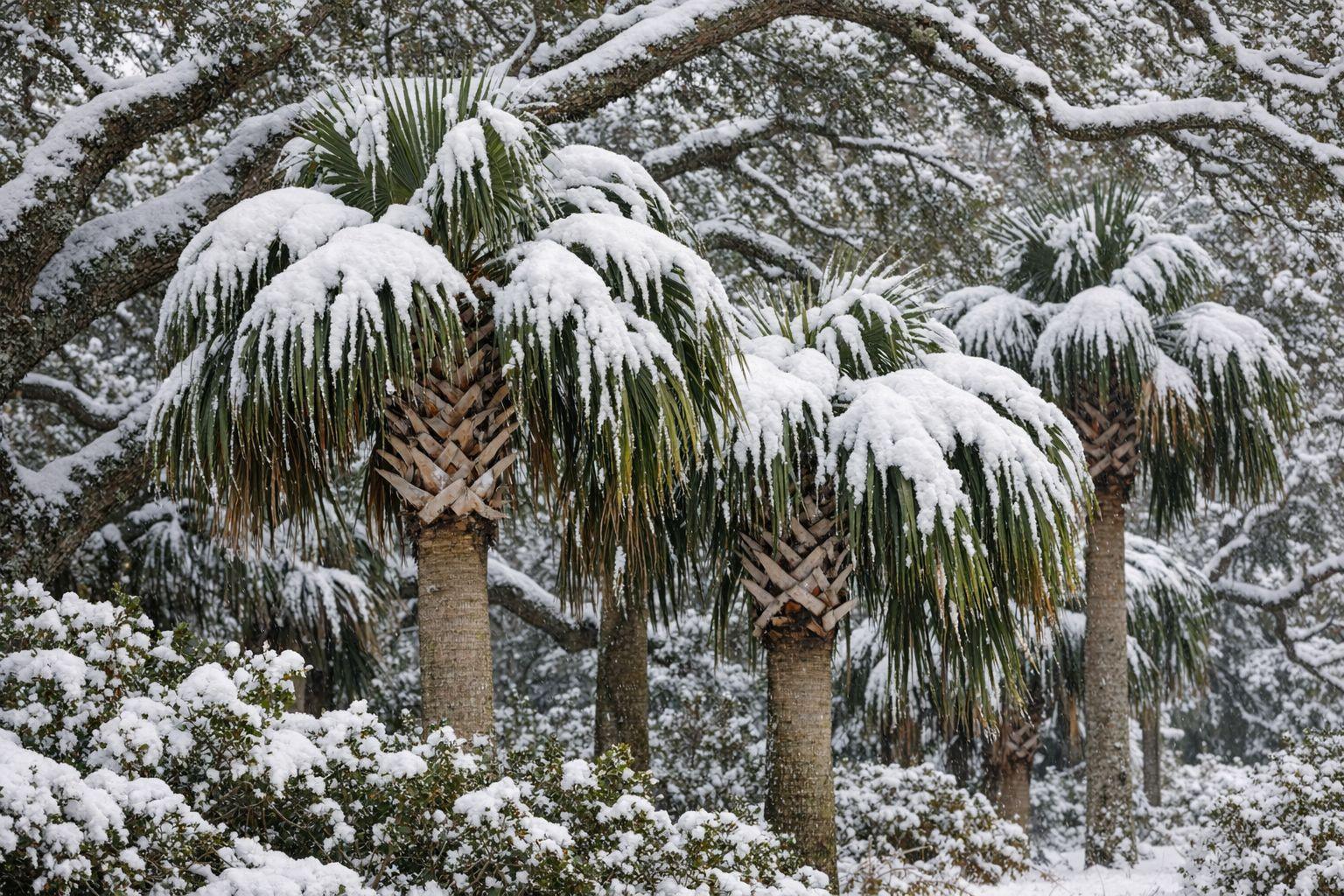
Christmas morning, 1989. Southport, North Carolina woke up under more than a foot of snow, and the thermometer read three degrees below zero.
Just across the mouth of the Cape Fear River sits Bald Head Island, home to the northernmost native stand of cabbage palms in the country. Sabal palmetto. The Florida state tree. The palm on the South Carolina flag. The one you picture leaning over a beach on a postcard.
That postcard palm has an edge, it turns out. And the edge looks nothing like a postcard.
The Bald Head Woods Coastal Reserve protects 191 acres of maritime forest on the island, and the state of North Carolina describes the cabbage palmetto there as growing at the northern extent of its range. The palms don't stand alone on the sand. They grow up through an understory of live oaks and laurel oaks, some of those oaks hundreds of years old, with American holly, dogwood and red cedar mixed in. The oaks take the salt spray and the wind. The palmettos tuck in underneath and push their fan-shaped crowns up into the canopy. It's less a tropical beach than a palm hiding in a southern hardwood forest.
And it has been tested. That 1989 storm dropped 15.3 inches of snow on Wilmington, a city record, and set Wilmington's all-time low at 0°F. Southport, the closest town to the island, hit minus three. Drive out there today and the woods are still full of palmettos.
Palm people, being palm people, still argue about the exact line. On PalmTalk, growers have pored over satellite images and pointed to a few scattered palmettos on nearby Oak Island and Battery Island that sit a hair farther north. Others suspect some of those were planted. Either way, the wild cabbage palm gives out right around 34 degrees north latitude.
Here's the part I love. Seed collected from that Bald Head stand is now grown by nurseries as its own selection. Plant Delights Nursery in Raleigh rates its 'Bald Head' palmetto to zone 7b, and says its oldest plants from those collections, now about 20 years old, have proven hardier than the other palmettos they've tried. Plants living at the cold edge of a range often carry the toughest genetics the species has. That's not a guarantee. It's a head start.
Which brings me to my own front yard in southeastern Wisconsin, a little over nine degrees of latitude north of Bald Head. My Sabal palmetto went in the ground on May 29 with a rootzone heat cable coiled around it. It put out three full fronds its first summer and was still pushing a spear in mid-October, which is not how a freshly planted palmetto is supposed to behave. This winter is its first. It hasn't proven a thing yet, and I'm not going to pretend otherwise. It goes in an insulated box with a small heater, and come spring we'll all find out together.
When the wind comes off the lake this January, I'll be thinking about those woods on Christmas morning in 1989. Beach palms sitting in snow under the live oaks, doing exactly what nobody expected them to do.
Has anyone out there grown a Bald Head seed-strain palmetto north of zone 7? I'd love to hear how it handled a real winter.
Until next time,
— Tim