
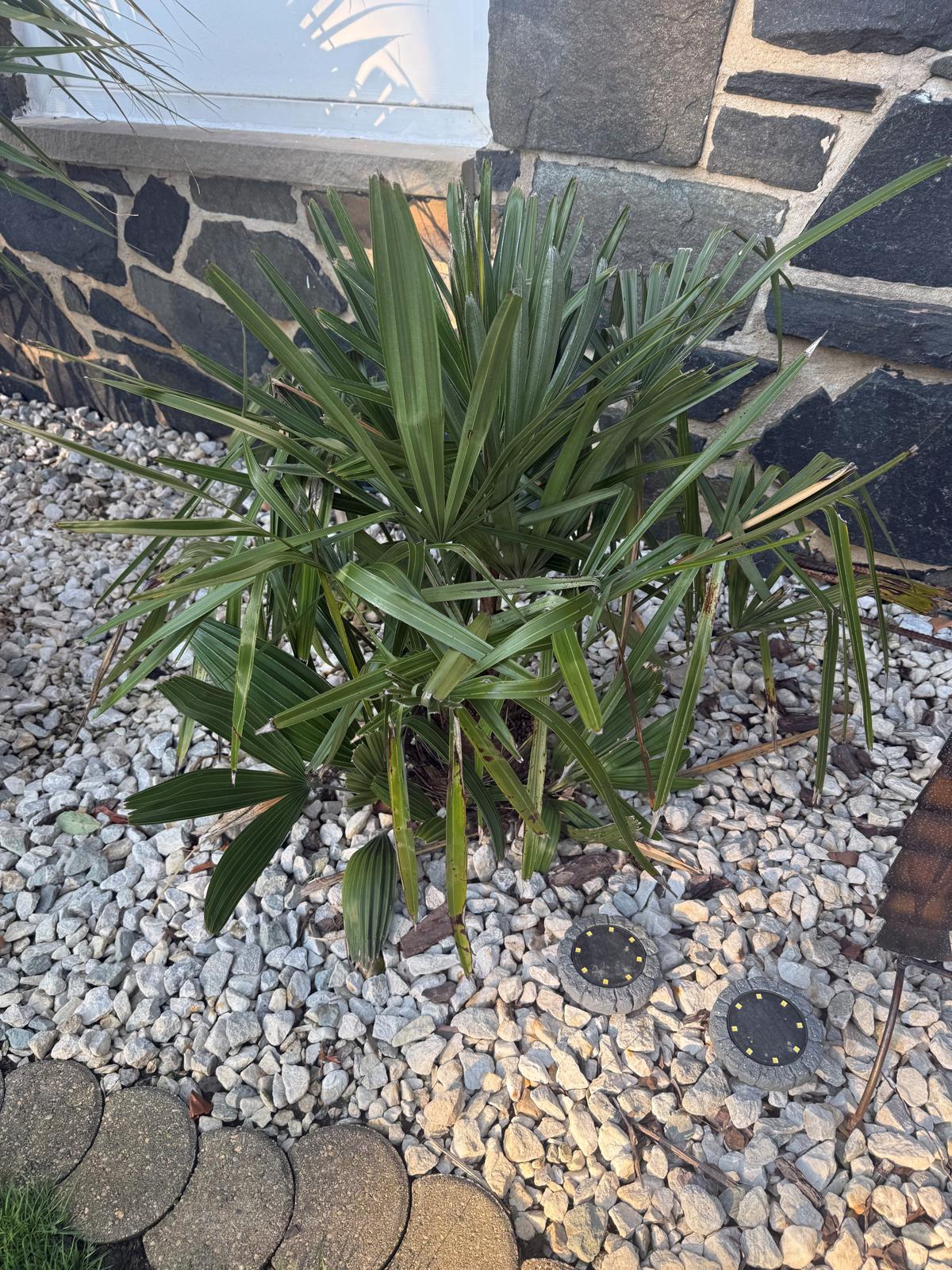
A pot of needle palm seeds took almost two years to give me much of anything.
I sowed 100 Rhapidophyllum hystrix seeds back in 2024. Needle palm is one of the three palms I grow in the ground here in Saukville, along with windmill and Phoenix sylvestris, so starting my own from seed felt like a natural next step. Then the seeds did what needle palm seeds are known for. They took their time. A lot of it.
On November 1 I finally tipped that crowded communal pot out and gave every seedling its own one gallon home. The final count was thirteen. Thirteen out of a hundred, about 13 percent.
My first reaction was a little sheepish. Then I went looking at what the people who study this plant have found, and I felt a lot better.
Back in 1988, Keith Clancy and Michael Sullivan published a study of needle palm germination in Principes, the journal of the International Palm Society. Seeds they planted with only the fruit flesh cleaned off took 435 days to send up the first sprout. By day 530, just 11 of 77 had germinated. That's 14.3 percent. Their best group, seeds that were cold treated and nicked before planting, started sprouting in about six weeks but still topped out at 18 percent. Other reports they cite put the wait anywhere from six months to two years. My batch landed right in that range on both counts.
It makes more sense once you look at how this palm lives in the wild. The needle palm grows in the shady floodplains and swampy bottoms of the Southeast, from Florida into South Carolina and west to Mississippi. Nobody has pinned down an animal that reliably spreads its seed. A lot of the fruit simply drops and sprouts at the base of the mother plant, where the seedlings rarely make it. Clancy and Sullivan found almost no wild seedlings older than about three years. This is a palm that holds its ground by clumping and sending up offshoots, not by flinging seed across the landscape.
And the slow part isn't over. Needle palm seedlings typically don't push their first divided, fan shaped leaf until about three years after germination. Until then it's simple strap leaves, roughly nine of them before the first real fan shows up. These thirteen have a long runway ahead.
That's what I love about this plant. Once it's established, it's one of the toughest palms there is. My two in-ground needle palms have come through three Wisconsin winters since going in the ground in spring 2023. One of them lost its main trunk in the winter of 2024-25 and came back from its offshoots. All that toughness at the top end comes with a tiny, slow, stubborn start at the bottom.
So I won't pretend I have a secret germination trick. I sowed a hundred seeds, I waited, and thirteen showed up. Sometimes patience is the whole method.
Have you ever grown needle palm from seed? How long did yours make you wait?
Until next time,
— Tim