
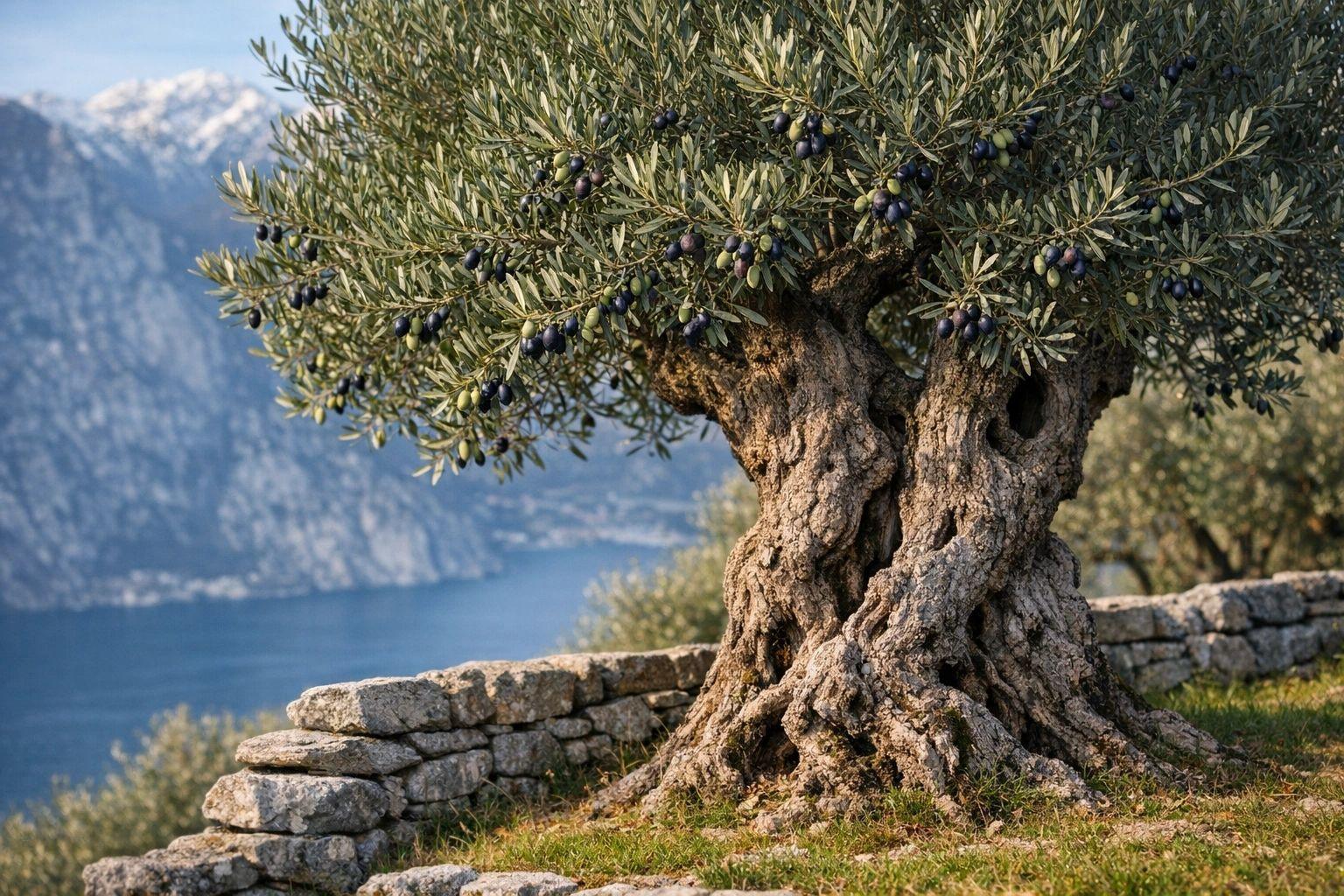
Forty-five degrees, fifty-three minutes north.
That's the latitude of Riva del Garda, a little town at the top of Lake Garda in northern Italy, tucked right under the Alps. It's also home to what the locals proudly call the northernmost olive groves in the world. My yard in Saukville sits at about 43 degrees. Do the math and those olive trees are growing roughly 170 miles closer to the North Pole than I am.
I had to read that twice.
Latitude isn't climate, of course. Riva's January averages run from about 30 to 43°F, and the big lake next door keeps the worst of the cold off the groves. Sound familiar? Lake Michigan does a version of the same thing for me, though I'll be the first to tell you the lake buys time, not warmth. Garda just buys a lot more of both.
Now the numbers that matter. Olea europaea, the common olive, starts losing leaves and small twigs around 17°F. Young trees can die in the mid 20s. A mature tree gets knocked to the ground somewhere around 15°F and below. Southeastern Wisconsin sees below zero most winters. On paper, this is a very short conversation.
But the olive has a trick, and it's the reason I can't stop thinking about this one.
In January 1985 a brutal cold wave hit southern Europe. Around Riva it dropped to about 7°F in town and close to 2 below in the countryside, and olive trunks split open. In Tuscany the same freeze killed much of the wood above ground across whole hillsides. Then the trees came back from the roots. Growers pruned around the new shoots, and those regrown trees are still standing in the groves today. An olive that loses its top isn't necessarily a dead olive.
There's a second detail I love. In January 2021 Riva dipped to about 21°F and the groves came through fine. The local paper gave the reason: the afternoons climbed back above freezing. In 1985 they didn't. That's the same rule I use on my windmill palm. A 15°F night doesn't scare me if the next day gets above 32. Cold that lets go in the afternoon is a different animal than cold that moves in for a week.
So what would it take here? There's no olive in my yard, so this is pure what-if. I'd start with a variety that already lives in cold groves, like the Frantoio grown around Garda. I'd plant it in spring, never fall, so it gets a full season to root in. Then it would get the same treatment my Phoenix sylvestris gets: a box for winter and warm soil underneath. The Phoenix came through its first winter that way, out in the open with no wall to lean on. And here's the funny part. Olives actually need a real winter chill to set flowers at all. They don't want Florida. They want cold, just not Wisconsin cold.
Would it ever give me a jar of olives? I wouldn't bet the truck on it. Would it stay alive, maybe dying back and coming again from the roots like those Tuscan trees? I think it has a shot, and that's enough to keep me wondering.
Is anybody out there growing an olive in the ground north of zone 7? I want to hear how it went, good or bad.
Until next time,
— Tim