
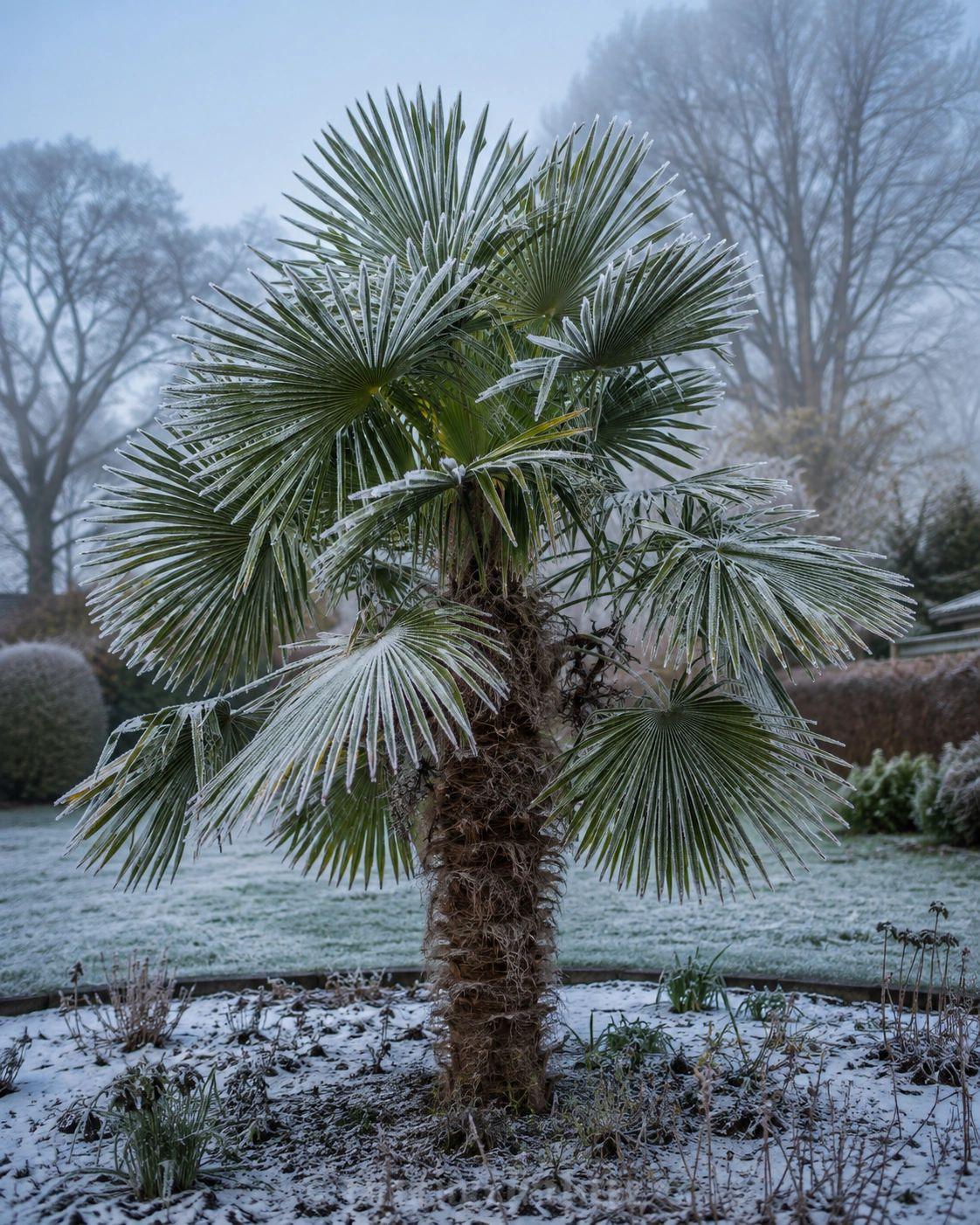
Ask most people how a windmill palm survives a night in the teens and they'll tell you it just toughens up, the way a person gets used to cold weather after a few winters. That's not wrong exactly, but it skips the actual mechanism, and the mechanism is stranger and more interesting than “toughens up.”
What's really happening inside the leaf is called supercooling. Water needs something to grab onto before it can freeze, a nucleation point, and the fluid inside a cold hardy palm's cells resists forming one. So the water inside the leaf stays liquid well below freezing, even while ice is already forming everywhere around it.
Where that ice actually forms matters more than most people realize. Researchers studying frost hardy palms, Trachycarpus fortunei among them, the same windmill palm I've been growing since 2008, have documented two distinct freezing events inside a single leaf. The first happens outside the cells, in the space between them, and it's mostly survivable. The second happens when ice finally breaks through and forms inside the cell itself, and that one kills the tissue. A cold hardy palm's whole advantage comes down to how long it can hold that line and keep the ice on the outside.
Here's the part that ties straight back to something I've been saying for years without knowing the science behind it. When ice forms outside a cell, it pulls water out of the cell to feed itself. The cell doesn't freeze solid so much as it dehydrates. Freezing and drying out turn out to be the same event wearing two different names. I've talked before about how a palm dies of thirst more often than it dies of cold, roots too cold to move water even when the ground has plenty of it. Turns out the leaf tissue is playing out a version of the same story at a smaller scale, just faster and colder.
This is also why I don't rush to box a windmill palm at the first cold snap. Cold acclimation is real, and a palm that gets to experience real cold gradually, without a rescue every single night, builds a bigger margin between the two freezing events I mentioned. Box it too early and too often and it never gets the chance to do that work. I want it to experience cold. I want it to use its hardiness to its advantage, and I mean that more literally than I used to.
None of this means I've stopped running a rootzone cable under the plants that need one. If anything, the research makes the case for it stronger. Warm roots keep water moving up into the plant, which gives the leaf tissue more to work with when it's fighting to stay hydrated through a freeze. Cold hardiness isn't one trick. It's a water management problem with a temperature twist, and every piece of my setup, the box, the cable, the timing of when I cover a plant versus letting it sit in the cold, is really just me trying to keep water on the plant's side of that fight.
I'll be honest, there's plenty here I still can't fully explain, same as with the box and its air gap. I know it works better than I can describe why. But it's a good feeling when actual plant science lines up with fifteen plus years of watching what lives and what doesn't in my own backyard.
Until next time,
— Tim